Australian Learner Competency Credential
The Australian Learner Competency Credential is issued to school students across Australia to recognise areas of their learning success that is not captured in traditional examinations or transcripts for use in key transitions.
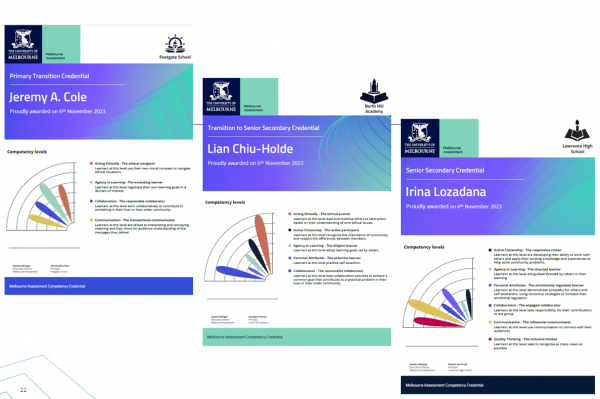
Students who are at key transition points in their schooling – primary to secondary, middle to senior years, secondary to post-secondary – are being issued the Australian Learner Competency Credential (the Australian LCC). This new qualification focuses on the complex competencies learners develop throughout their schooling years that enhance their ability to thrive in further education and future employment, such as critical thinking, collaboration, communication, active citizenship, and agency in learning. It is designed to complement existing measures of domain-based knowledge and skills, such as school reports, NAPLAN and the ATAR.
The Australian LCC is warranted by the University of Melbourne’s Melbourne Metrics, which provides national and international education systems with evidence-based assessment tools and credentials.
Enterprise Professor Sandra Milligan, Executive Director of Melbourne Metrics, notes the new credentials will help students prepare for a rapidly changing future: “Traditional metrics of learning and schooling success report what a learner knows about a particular subject or topic, or what they can do under timed, high-stakes tests or examinations. But to thrive in a modern AI world, students need to be able to demonstrate more than that. They need to be collaborative, build and maintain connections, act ethically, be entrepreneurial, be critical thinkers and reflective. Such qualities are what this new credential is all about.”
The 1083 learners receiving the qualification in 2024 attend government, independent and catholic schools from across Australia (VIC, NSW, QLD, SA, TAS, WA). These ‘first mover’ schools are involved in the University’s New Metrics research-practice partnership, which supports educators to use ‘next-generation’ measures to teach, assess and credential a broad range of competencies.
The Australian LCC was first issued in 2023 by nine schools. More schools are expected to take up the opportunity to credential their students next year.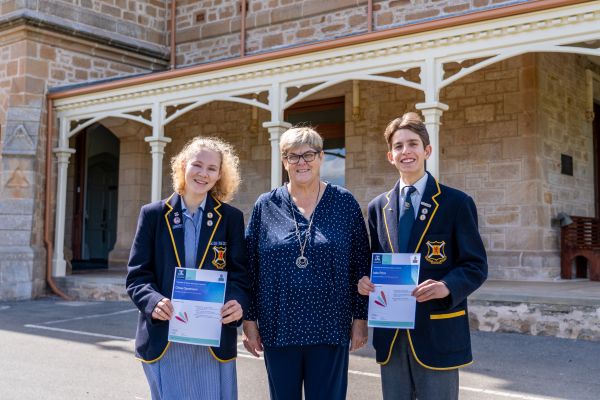
Teresa Hanel, Scotch College Adelaide's Deputy Principal Teaching & Learning, with Year 9 students Chloe Sorensen and Jake Prior. Photo: Scotch College Adelaide (2023)
Key Features of the Australian Learner Competency Credential:
- The competencies being credentialed include: Agency in Learning, Acting Ethically, Active Citizenship, Collaboration, Personal Development, Communication and Quality Thinking
- The credentials have been issued at key transition points in schooling: primary – secondary (Grade 6), transition to senior secondary (Year 9/Year 10), senior secondary (Year 11/Year 12)
- The credentials use validated and robust standards-based learning progressions to recognise learners’ competencies
- The credential complements existing measures of learning success
Twenty schools have issued the credentials, from across VIC, NSW, TAS, QLD, SA and WA, to 1083 learners (up from 254 in 2023). Schools involved include:
- All Saints' College (WA)
- Bayside P-12 College (VIC)
- Camberwell Girls Grammar School (VIC)
- Carey Baptist Grammar School (VIC)
- Clonard College (VIC)
- Emmanuel Anglican College (NSW)
- Genazzano FCJ College (VIC)
- Melaleuca Park Primary School (SA)
- Nangiloc Colignan & District Primary School (VIC)
- Naracoorte High School (SA)
- Princes Hill Primary School (VIC)
- Santa Sophia Catholic College (NSW)
- Scotch College Adelaide (SA)
- St Michael's Collegiate School (TAS)
- St Michael's Grammar School (VIC)
- Swan Valley Anglican Community School (WA)
- The Knox School (VIC)
- Wesley College (VIC)
- Woodleigh School (VIC)
- Wurun Senior Campus (VIC)
- Yeronga State High School (QLD)
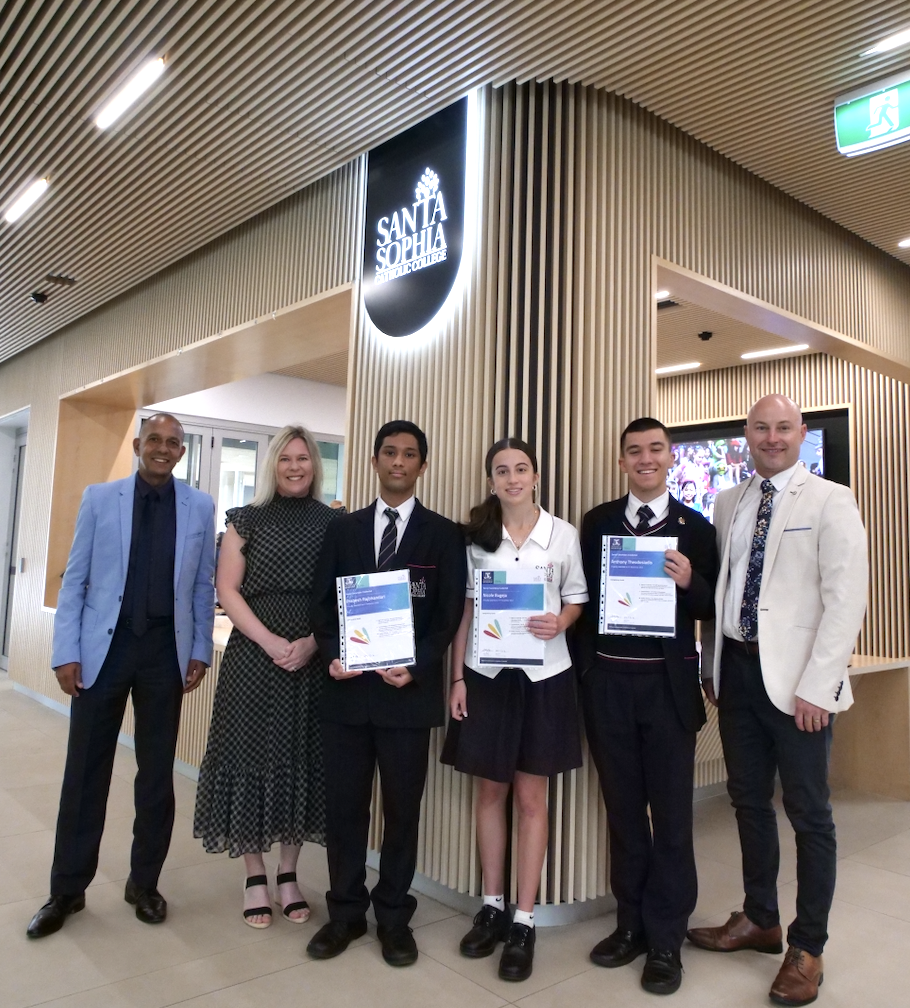
Teachers and students at Santa Sophia Catholic College posing with their credentials. From left to right: Mark De Vries (Principal), Lisa Kalocsai (Head of School), Prabesh Rajbhandari, Nicole Bugeja, Anthony Theodosiadis, Chris Maguire (Leader of Innovation and Digital Learning). Photo: Santa Sophia Catholic College (2023)
School's Testimonials
All Saints' College, WA
Belinda Provis, Principal
All Saints' College, WA
Shannon Armitage, Director of Senior School (Teaching and Learning)
Carey Baptist Grammar School, VIC
Jonathan Walter, Principal
Melaleuca Park Primary School, SA
Erica Hurley, Principal
Santa Sophia Catholic College, NSW
Nicole, Year 12 student
Scotch College Adelaide, SA
Trent Driver, Principal
Swan Valley Anglican Community School, WA
Melissa Powell, Principal
Wesley College, VIC
Cameron Paterson, Director of Learning
Woodleigh School, VIC
David Baker, Principal
Wurun Senior Campus, VIC
Christopher Millard, Campus Principal