2023 FoE Alumni Early Career Award
This award recognises excellence, innovation and leadership in contribution to education by an alumni who graduated from FoE in the previous eight years.
Dr Mousumi Mukherjee
Associate Professor & Deputy Director, International Institute for Higher Education Research & Capacity Building Founding Executive Director, Centre for Comparative and Global Education

Dr Mousumi Mukherjee has made substantial contributions in comparative and international education. Currently she serves as Associate Professor and Deputy Director of the International Institute for Higher Education Research and Capacity Building, O.P. Jindal Global University within 8 years following her PhD from the Faculty of Education in 2015. She also serves as the Founding Executive Director of the Centre for Comparative and Global Education, O.P. Jindal Global University.
Dr Mousumi Mukherjee is also an Honorary Senior Fellow of the University of Melbourne Faculty of Education. She received her PhD from the University of Melbourne and tertiary teaching certification from the Melbourne Centre for Studies in Higher Education in 2015. Her doctoral thesis received honourable mention as a runner-up to the 2016 Gail P. Kelly award for outstanding doctoral dissertation addressing social justice issues in education by the Comparative and International Education Society (USA).
Post-PhD from the University of Melbourne, she received a Fellowship and Networking Grant from the Oceania Comparative and International Education Society in 2016 to organize an international research symposium “Other Ways of Knowing and Doing: Globalizing Social Science Knowledge in Higher Education.” She also guest-edited special issue of the International Education Journal: Comparative Perspectives on the same theme published by the University of Sydney Open Journal system and has also contributed towards Southern Theoretical understanding of the concept of lifelong learning by drawing on Indian educational philosopher, J. Krishnamurty. (Mukherjee, M. & Agarwal, S. (July, 202I). Decolonizing Lifelong Education: Learning from J. Krishnamurti, Tiffany Prete & Elizabeth A Lange [Eds.] Special Issue: - Indigenous Voices and Decolonizing Lifelong Education. International Journal of Lifelong Education, Taylor & Francis.
Dr Mousumi Mukherjee is continuing to contribute towards further development of Southern Theory by mentoring a doctoral candidate, who in the process of authoring a monograph on Dalai Lama’s Philosophy of Education. She is engaged locally and globally building research networks and partnerships. She is a member of the Association of Commonwealth Universities’ Supporting Research Community. She is the Vice-President of Research and Partnerships Development of the STAR Scholars Network, a Research Standing Committee Member of the World Council of Comparative Education Societies. She serves as the Internal Quality Assurance Advisory Board Member of Adamas University, Kolkata, India, and serves as the International Education Advisory Board Member of the Morgan State University, USA.
Dr Mousumi Mukherjee has over 20 years’ comparative experience in the higher education sector in India, United States and Australia. She has received several awards for her exemplary teaching, research and community engagement. She is a distinguished Fulbright alumna. She received Phi Beta Delta Honour Society Medallion for her contribution in International Education, the Washington Centre Civic Engagement award, and Graduate Women Victoria International Doctoral Scholarship. She has published over 30 internationally peer-reviewed journal articles, book chapters and a co-edited book with reputed publishers, such as Routledge, Brill-Sense, Sage, Springer and Oxford University Press. She has also worked as educational consultant with national and global organizations, such as NCERT, UNESCO-IIEP and the World Bank.
At the national level within India, recently she has received a major research grant from the Indian Council of Social Science Research, Government of India. One of the doctoral research fellows working under her supervision has also received the prestigious non-residential Fellowship from the Foundation for Universal Responsibility of HH the Dalai Lama to write a monograph on Dalai Lama's Philosophy of Education titled:- "The Becoming: The XIV Dalai Lama on Education"
Ms Caitlin Powell
Year 12 Coordinator, St Paul's Anglican Grammar
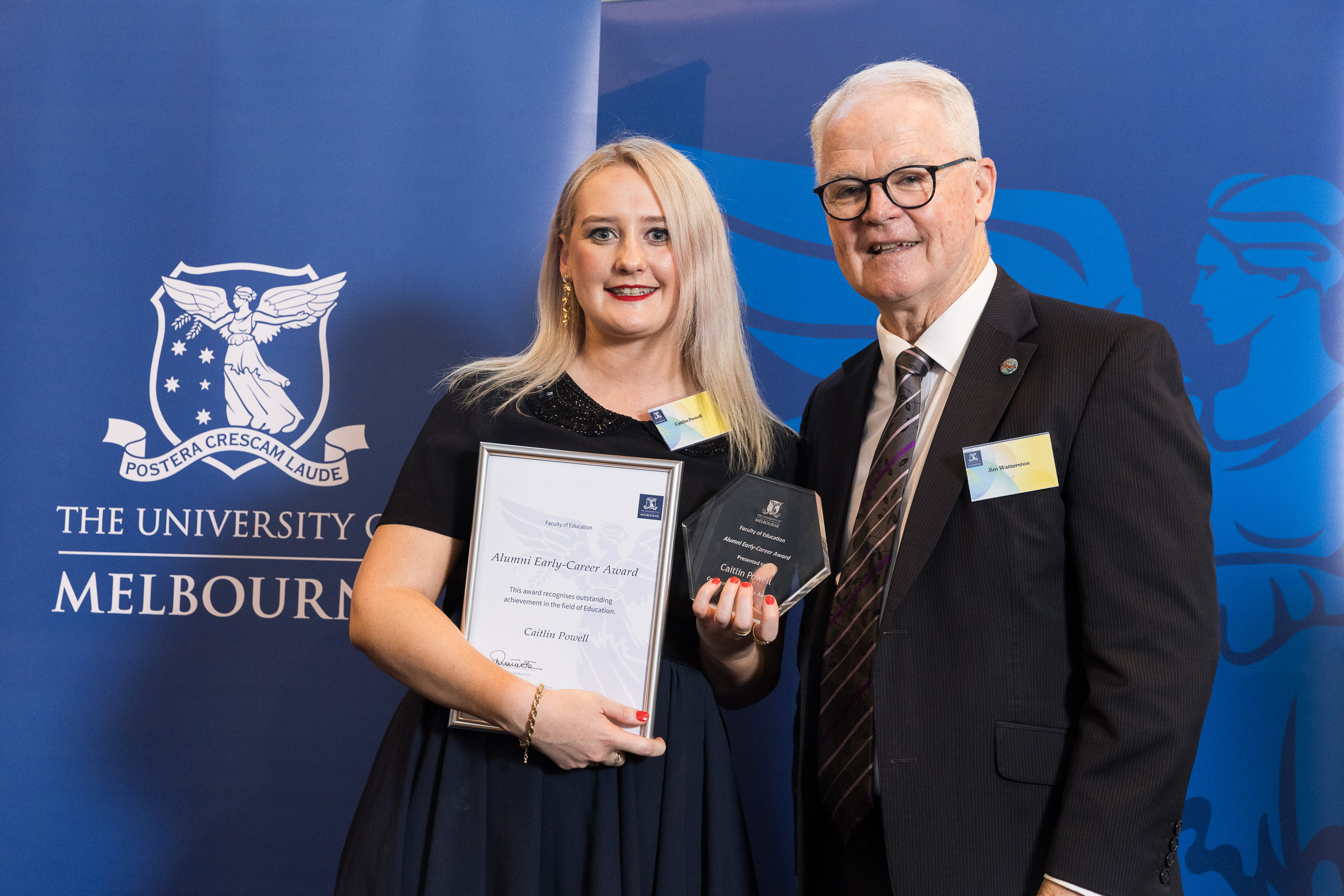
Caitlin has contributed to various communities in her Early Career, inclusive of; regional equity in education and raising awareness for First Nations education and projects within her teaching.
As a graduate teacher Caitlin took on a teaching position at Kyabram P-12 College where she was given a teaching load of two Year 12 classes, one of which was combined lass. The dedication to excellence which Caitlin showed in her graduate year was reflected not only in her students’ results but also in the ripple affect she had on the school community. Two of Caitlin’s students received early offers to the Victorian College of the Arts as a result of her mentoring. Caitlin dedicated time to learning innovative practices across all methods of Visual Arts in order to engage students across the College. This innovation is evident in her ability to target the individual student’s talents in order to make their creative studies relevant and engaging; as Art is a core subject, Caitlin has had to contend with students resisting engagement, however, her belief that art has an important role to play in wellbeing underpins her practice and allows her to find a way to make relevance for all students. In one instance, this even meant allowing a student to bring in his pet chicken for a live drawing class. Caitlin always puts the students at the core of her work in education, and beyond the classroom she has taken on the role of Year Level Coordinator at all the schools she had worked at. Currently, she is the Year 12 Coordinator at St Paul’s Anglican Grammar. She leads by example, always treating students with resect, dignity and never shying away from meeting them on their level in extra-curricular activities. Likewise, she treats her colleagues with professionalism and respect, always open to learning from others. She wants the best for all of her students and is vocal about the notion of education as a pathway to any avenue; to Caitlin, learning does not occur only in the classroom, and she models this daily in her approach to leadership.
During her time in Kyabram, Caitlin was a driving force for collaboration in the arts sector of the local community. Some of Caitlin’s achievements in the Kyabram community include: organising an exhibition of student art from various schools in the region; creating a network of art teachers in the Goulburn Valley, from varying education sectors, who can collaborate to give the best opportunities to their regional students; volunteering at the annual Kyabram Debutante Ball and community theatre as a set designer and painter. These demonstrate Caitlin’s ability to marry her role as educator to that of community member, knowing that in a small town like Kyabram success in one role is dependent on the other. Similarly, Caitlin took every opportunity she could do bring students into community contributions with her, allowing them access to art projects first hand. Furthermore, Caitlin collaborated with local Bangarang and Yorta Yorta peoples to design and construct an Indigenous Garden at Kyabram P-12. The project was originally part of the College’s NAIDOC week activities, but Caitlin garnered the support of her classes to keep the project as a school priority.
Over the course her teaching career, the strongest theme in her work is Caitlin’s active stance on closing the gap and addressing equity divided in education. She has consistently worked in the fields of Indigenous equity in education as well as the equity issues facing rural and regional students. Caitlin has volunteered with the Indigenous Student Success Program through the University of Melbourne, attending camps with her own students but also assisting in program development. In 2018 Caitlin was asked to go to Mildura to work with Indigenous Students in an art program. This sustained record is reflected in her commitment to the Indigenous Garden in Kyabram, and more recently the way that she teaches First Nations art with cultural appropriateness and sensitivity in the classroom; Caitlin understands that one of the first steps in addressing equity issues is to teach about them. She instils in her students the desire to perpetuate the fight for equity. One of her career goals is to work in remote communities of Australia. Caitlin has always pursued jobs in regional Victoria believing that access to quality education is not a luxury for metropolitan students. In both Warragul and Kyabram she exposes students to a range of possible futures; excursions into Melbourne, partnerships with local community projects and is willing to share her own lived experience of pursuing the arts.