Co-designing inclusive BMX spaces for riders with disability
Project description
This project aims to co-design guidelines for accessible and inclusive Bicycle Motocross (BMX) spaces that cater to riders with disabilities, including physical, psychosocial, intellectual, and sensory disabilities. Adaptive BMX, also known as ParaBMX, is an emerging sport internationally. The goal is to better understand how to create conditions for social inclusion facilitated through sports such as ParaBMX. Through participatory methods, we will engage BMX riders with disabilities, advocates, and support networks to explore universal design principles and develop materials for adapting BMX facilities, events, and programs.
This project synergises expertise across education, inclusive design, Parasports, disability advocacy, participatory methods, and BMX culture - essential for holistically understanding and designing accessibility solutions. It includes academic researchers collaborating with community organisations.
This project is generously supported by funding from the Melbourne Disability Institute.
Project outcomes
The knowledge gained from this project will be utilised in various ways to promote inclusive and accessible BMX facilities and programs for people with disabilities. The primary output, the inclusive design guidelines, will directly inform policies and practices related to the development of accommodating BMX spaces and initiatives. These guidelines will provide a comprehensive framework for stakeholders, such as local councils, cycling organisations, and community groups, to ensure that BMX facilities and programs are designed and implemented with universal design principles in mind. By taking a co-design approach, this project gives voice to the disability community to identify the key challenges and co-create solutions.
This project will employ an adapted experience-based co-design (EBCD), a participatory approach that brings together people with lived experiences and relevant stakeholders to co-design guidelines. By facilitating greater accessibility and participation in BMX for individuals with disabilities, the project has the potential to promote physical activity, social inclusion, personal growth, and overall well-being for people with disabilities and their families.
Project outputs
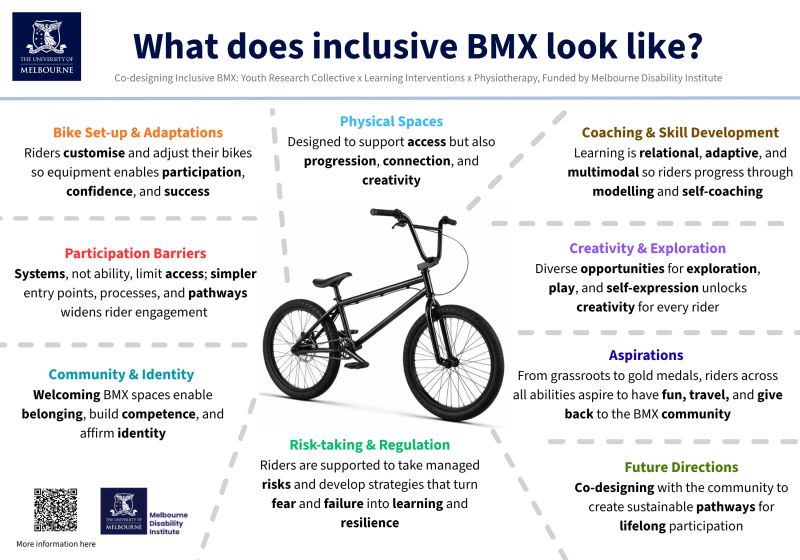
Our Inclusive Guidelines poster is a one‑page portrait resource that summarises practical, evidence‑informed steps to make BMX welcoming for riders of all abilities. Co‑produced with riders, carers and disability specialists, it presents the "9 parts of inclusive BMX" in plain language with quick, actionable tips for clubs, coaches and event organisers. Designed for clarity and accessibility, the poster is free to download.
Research team
Lead Researchers
Dave Camilleri
Dr Dave Camilleri (Ph.D in Learning Sciences, M.Teach (Sec), M.Ed (Wellbeing), M.A Phil., B.A. Philosophy (Hons)) is a passionate early career researcher with an interest in inclusive sports and using creativity to amplify marginalised voices. As a CALD student with ADHD who dropped out of school at year 10, he experienced firsthand how traditional schooling and sports exclude those who are different. After finding BMX as a teen, Dave found his people and eventually his way back to education. This drives his commitment to co-designing accessible BMX spaces for the community.
Drawing on his expertise in BMX, education, creativity studies, and youth engagement, Dave believes BMX offers a unique outlet for human potential across all abilities. He has recently published on BMX and creativity with papers exploring BMX as a mental health promotion tool currently under review. His research explores how hands-on activities such as BMX can nurture creativity, resilience, and belonging and be an empowering platform for social inclusion through adapted and alternative physical pursuits.
Rachel Toovey
Dr Rachel Toovey (PhD, MPHTM, BPhysio(Hons)) is a Senior Lecturer and Physiotherapist with the Department of Physiotherapy at the University of Melbourne. Rachel works with individuals, families, communities and organisations to create change and improve health through inclusive participatory research and evaluation, with a focus on young people with disability and sport. Rachel is Chief Investigator for the $1.4M NHMRC funded CycLink Partnership Project, a 5-year program of work to implement and evaluate the co-designed CycLink Program at 4 sites with over 100 children with disability, and their families, across metropolitan and regional Victoria. Relative to opportunity, Dr Toovey is 3.5 years post-PhD and has published 25 articles in peer-reviewed journals, has an H-Index of 9 and a 5-year average Field Weighted Citation Index of 2.19.
Matthew Harrison
Associate Professor Matthew Harrison is an experienced teacher, researcher and digital creator with a passion for utilising technology to enhance social capacity building, belonging and inclusion in education. He has taught in Australia, South Korea and the United Kingdom at primary, secondary and tertiary levels. Matthew is currently coordinating Autism Intervention within the Master of Evidence-based Teaching, and previously served as the Director of Professional and Continuing Education (PACE) and Co-Director of Student Experience at the University of Melbourne Faculty of Education. His research primarily focuses on neurodiversity and inclusive education.
Research Fellow
Miriam Yates
Miriam Yates (BPhty) is a research assistant with a background in physiotherapy. She has worked with Dr Rachel Toovey and John Carey previously on the CycLink Co-design project and also works with the team at Healthy Trajectories on a variety of projects. Miriam lives on Taungurang land in Central Victoria and is the parent of two children, one who learnt to ride a bike easily and successfully rides around the small country town, and one who has a disability and has not yet found quite the right bike or space to ride. Bike riding together as a family for fun, friendship and fitness remains an ongoing future-driven goal. Miriam’s family have experienced the joys and great value (and some of the challenges) of inclusion, participation and belonging within sports and other community-based groups and these experiences continue to drive Miriam’s work.
Steering group
Khalen Young
CEO of Karlup Wheels in Motion Indigenous Corporation, an organization dedicated to promoting cycling opportunities and community engagement for Indigenous Australians. A former BMX Olympian, Khalen brings a wealth of experience in elite sports, mentorship, and community outreach. His extensive work with young people with disabilities underscores his commitment to fostering inclusive and adaptive sports environments. Through Karlup Wheels in Motion, Khalen is dedicated to breaking down barriers in BMX and ensuring that all individuals, regardless of ability, have access to cycling opportunities that promote health, well-being, and social connection.
Sam Runge
A passionate BMX rider and brain tumour survivor, Sam’s journey in BMX has been defined by determination, perseverance, and an unwavering love for the sport. Overcoming significant health challenges, he uses BMX as both a personal outlet and a means to connect with his community. His experiences have given him a unique perspective on inclusive BMX participation, and he continues to push boundaries, proving that challenges can be transformed into strengths—both on and off the bike.
E.K.
E.K. grew up riding BMX and has a lifelong passion for bikes and inclusive communities. She has worked as a bike mechanic, specialising in adapting bikes to support people with disabilities to ride confidently and safely. E.K brings practical expertise and a deep commitment to accessibility in cycling.
Project advisor
John Carey
John Carey is a Physiotherapist and PhD Candidate at the University of Melbourne, interested in connecting young people with disability to physical activity and sport. His PhD uses participatory methods to involve young people with disability, parents and community partners in resource development. Collaborative outputs have included the CHAIN online training program, adapted co-design methods and program principles for the CycLink intervention. Clinically, he has worked in Ireland, the United Kingdom, New Zealand and Australia. He continues to practice as a senior physiotherapist in community health and special education.