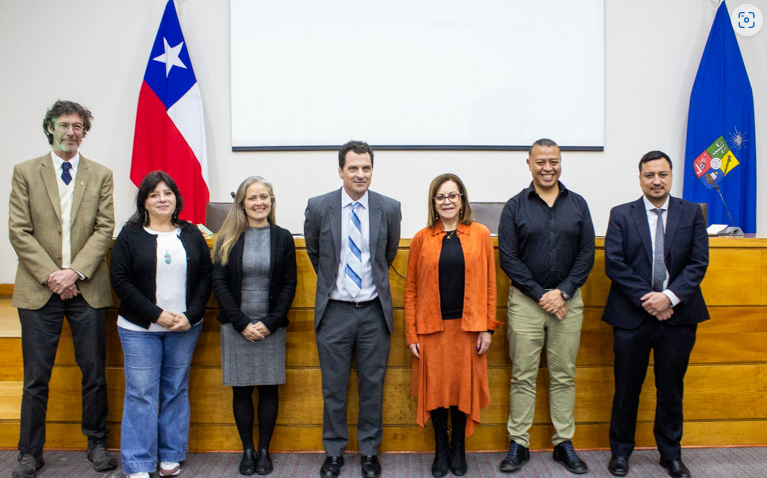
Prof. Therese N. Hopfenbeck presents with the International Scientific Committee in Chile
The International Scientific Committee was represented at the International Seminar "Social Legitimacy, Validity and Participation in Access to Higher Education" which took place Tuesday 3 September 2024, at the Headquarters of the University of Chile and was organised by the Undersecretariat of Higher Education and the DEMRE of the University of Chile.
Its members stressed the importance of focusing on the Chilean educational context and warned about possible undesirable effects of commercial preparation mechanisms for university entrance exams. AERC's Professor Therese N. Hopfenbeck presented as a member of this committee.
Access to information, legitimacy and the need to make progress in improving the admission process were the main points addressed during the seminar and are in line with what this new committee must review. Thus, during the day, former student leaders also reaffirmed the commitment and the need to continue advancing in improving access to universities.
The International Scientific Committee is tasked to monitor and propose improvements to the university admission system in Chile.
As one of the committee member's, AERC's Professor Hopfenbeck, affirmed the need to analyse the contexts in which admission tests are given, both when developing them and when applying and/or interpreting them. In this regard, the academic said that "it is dangerous if we copy certain countries. Nothing can be replicated in the same way, it has to be adjusted, adapted to the specific context in which it is found" and added that, although standardised tests are important, they must be considered as "one part of the puzzle" and that it is necessary to consider the different actors involved.
Hopfenbeck explained that social legitimacy requires constant dialogue with stakeholders and the willingness to adapt the admission process, to advance in transparency by communicating the processes and criteria of this, as well as to evaluate its impacts.
Further details and the full article can be found via the following link International Seminar - Chile.