
Prepare for your placements
You must complete these steps before your first Master of Teaching placement.
-
- In the first year of your Master of Teaching, you’ll complete two placements: Engaging and Assessing Learners 1 (E&AL1) and Engaging and Assessing Learners 2 (E&AL2).
- Enrol in both subjects as soon as possible to ensure we can allocate you to a placement site in time. Failure to enrol may result in delayed placement.
If you’re considering other course options, or deferral, please take action ASAP!
-
- All students attending placement must hold a valid Victorian Working with Children Check (WWCC).
- Apply early, as processing times may take up to several weeks. If you’re offshore, ensure you arrive with enough time to have your WWCC application processed.
-
- Provide your Melbourne address and Australian domestic phone number through the student portal (my.unimelb) as soon as possible. Ensure this information is up-to-date, as we will use your address to help determine your placement location.
- If you change your address in the portal, or if you have a second address and are interested in completing placement in two locations, please notify us through the Education enquiry form.
- If you’re coming from overseas, you must update your Melbourne address within seven days of arriving in Australia (this is a requirement of your student visa).
-
- Sonia is our placement management system. After you enrol in your placement subjects, you’ll receive access to Sonia.
- You must complete all mandatory fields regarding your circumstances, as this information will be used to assign you an appropriate placement.
Once confirmed, changes to placement will only be considered under exceptional and extenuating circumstances.
-
- After you enrol, you’ll be assigned a series of short online modules to complete.
- You will be unable to start placement until all modules are completed.
-
- Your placement dates depend on which Master of Teaching stream you’re enrolled in. Take note of the first-year placement dates for your stream below.
- Ensure you are available for the full extent of both placements, as attendance requirements are strict. You must attend every day of your scheduled placements.
- Adjustments may be made if you are on an Academic Adjustment Plan (AAP).
-
- We will contact you through your student email for important updates and requests.
- You must check your email at least twice per week (including during University breaks or Leave periods).
- You will be informed of your placement location two weeks prior to the start date.
First-year placement dates 2027
Early Childhood
| First placement (E&AL1) | Second placement (E&AL2) |
|---|---|
| Mon 7 June 2027 – Mon 5 July 2027 (14 June excluded) | Mon 16 Aug 2027 –Fri 10 Sep 2027 |
Early Childhood and Primary
| First placement (E&AL1) | Second placement (E&AL2) |
|---|---|
| Fri 12 Mar 2027 –Thu 25 Mar 2027 Mon 26 Apr 2027 –Fri 7 May 2027 | Mon 16 Aug 2027 –Fri 10 Sep 2027 |
Primary
| First placement (E&AL1) | Second placement (E&AL2) |
|---|---|
| Wed 10 Mar 2027 –Thu 25 Mar 2027 | Mon 26 Apr 2027 –Fri 7 May 2027 |
Secondary
You will be placed in either Block 1 or Block 2. You cannot preference a block.
| Block 1 dates | Block 2 dates |
|---|---|
First placement (E&AL1) Fri 12 Mar 2027 –Thu 25 Mar 2027 | First placement (E&AL1) Fri 12 Mar 2027 –Thu 25 Mar 2027 |
Second placement (E&AL2) Mon 16 Aug 2027 –Fri 10 Sep 2027 | Second placement (E&AL2) Mon 8 Nov 2027 –Fri 3 Dec 2027 |
See below for more information on what your placements will entail.
Placement Expectations
Information on the teaching, observation, and professional activities Teacher Candidates are expected to complete during placement.
Placement Requirements
Information on the requirements, responsibilities, and conditions associated with placement, including preparation and participation expectations.
Health precautions, OH&S induction, and understanding insurance coverage on placement.
The Victorian Government and the University of Melbourne require anyone working or volunteering with children to meet a minimum checking standard.
Role definitions and minimum expectations of Teacher Candidates and Mentor Teachers.
Find out about core placement participation requirements.
Maintaining professional conduct and adhering to ethical guidelines during placements.
Compulsory seminars are held before the start of each placement.
Each placement is split to allow progression from observing to planning, teaching, reflecting, and documenting lessons under supervision.
Attendance policies and procedures for reporting absences during placements.
Satisfactory completion of each component is required to pass the placement hurdle requirement of the Engaging and Assessing Learners subject.
Placements are systematically monitored and may be subject to a progress review.
Placement Policies and Resources
Information on the policies, guidelines, and resources that support and govern placement processes.
Links to relevant forms.
Placements are governed by relevant University policies and guidelines.
Need more information?
About the Clinical Model*
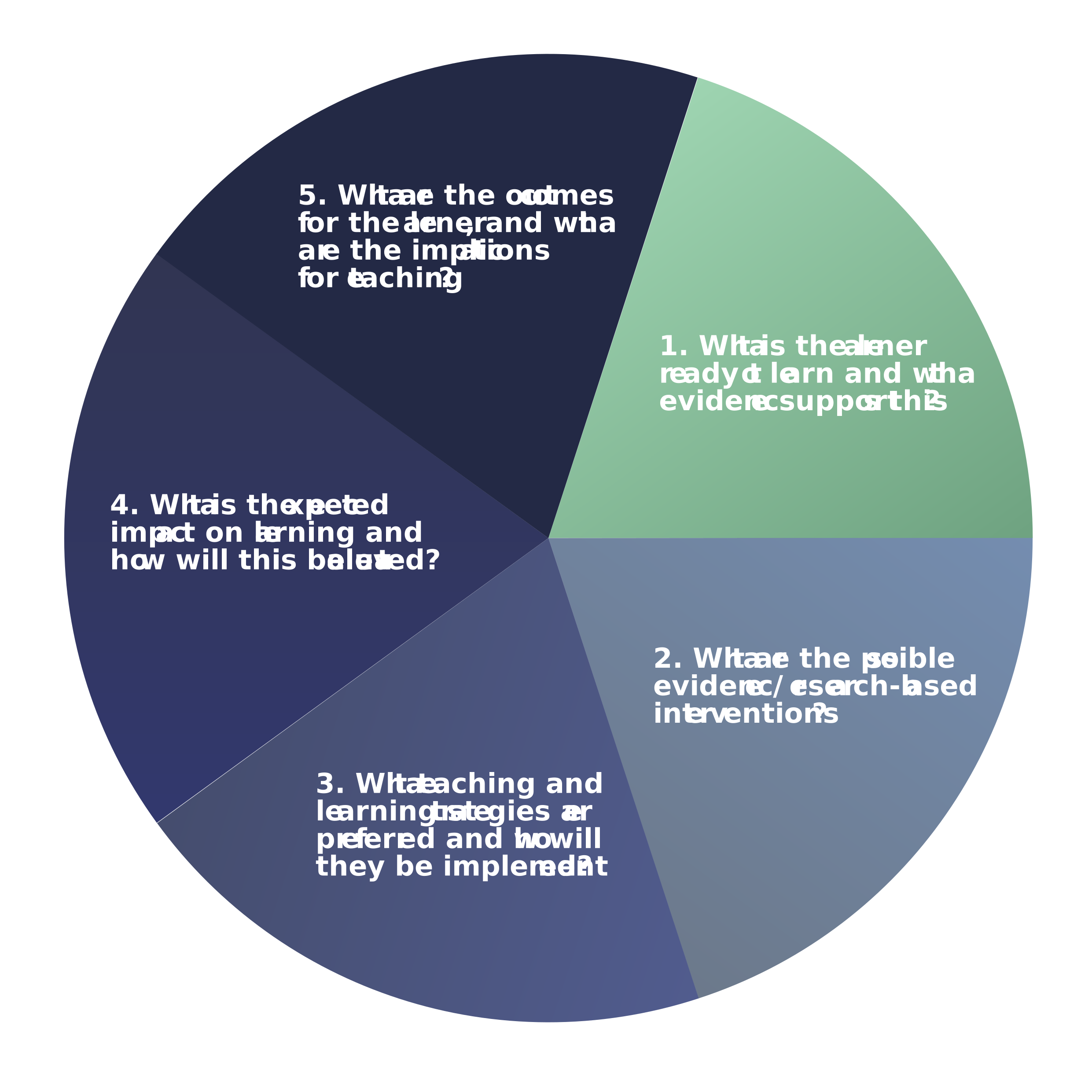
The Master of Teaching Clinical Model conceptual framework for Clinical Teaching is seen more broadly as a contribution to developing teaching as a profession, as it offers ways in which theory and practice are integrated in the daily work of teachers. The key to such transformation is praxis: the understanding, enactment and building of theory via practice.
There are three components that are central to characterising teaching as a clinical practice profession:
- A focus on student learning and development
- The development of clinical judgement which utilises an evidence base to understand learning needs and inform teaching strategies
- The integration of theory and practice through university-school partnerships that extend beyond the preparation of Teacher Candidates.
As a clinically based pre-service teacher education program, the Master of Teaching aims to develop teachers as interventionist practitioners with high-level analytic skills, who are capable of using data to identify and address the learning needs of individuals.
The role of the teacher as an ‘interventionist practitioner’ is informed by a solid theoretical and research base in learning and development, pedagogy, curriculum and assessment which enables a strengths-based approach to ensure every learner can be successful.