Transforming the future of leadership development through Virtual Reality and Artificial Intelligence
School leadership is complex, relational and often high stakes. Aspiring school leaders are expected to communicate clearly with teachers, parents, school boards and wider communities, often in situations marked by pressure, uncertainty and competing expectations. Yet many have limited opportunities to practise these conversations before they enter leadership roles.
The project, led by Dr Donnie Adams from the Faculty of Education and supported by a team comprising Mr Ben Loveridge, Professor David Gurr, Associate Professor Lawrie Drysdale, and Dr Pauline Thompson, brings together expertise in educational leadership, immersive learning, and virtual reality (VR) technology to respond to that challenge.
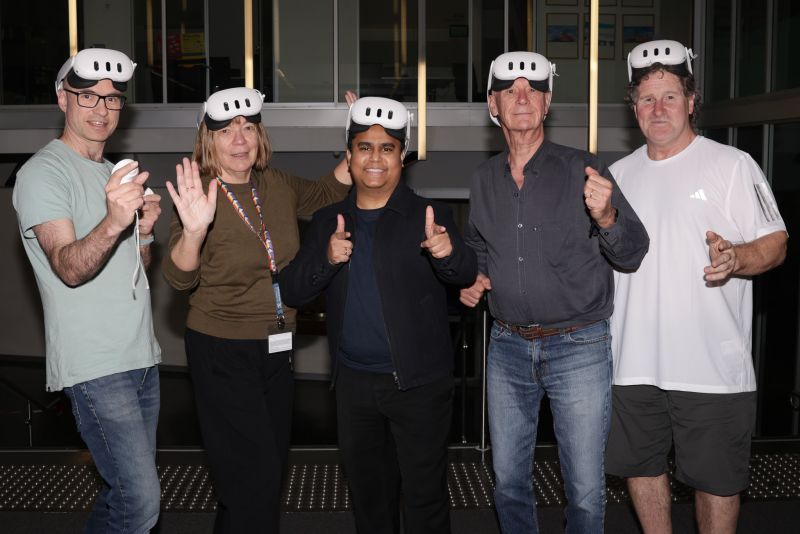
From left to right: Mr Ben Loveridge, Dr Pauline Thompson, Dr Donnie Adams, Associate Professor Lawrie Drysdale and Professor David Gurr
Preparing aspiring school leaders for the conversations that matter
Educational leadership programs have long provided students with strong theoretical foundations. Aspiring school leaders learn about leadership models, school improvement, instructional leadership, organisational change and effective communication. However, a persistent challenge remains: how do we put this knowledge into practice in real school settings?
Unlike traditional classroom-based approaches, VR allows aspiring leaders to enter realistic scenarios and practise high-stakes conversations before they encounter them in schools. The integration of artificial intelligence (AI) adds a further layer of innovation. Participants do not simply enter a simulated environment; they interact with responsive avatars and receive analytics-informed feedback on aspects to improve in their performance and communication, such as tone, pace, eye contact, and use of filler words.
The project uses VR simulations to recreate realistic school scenarios. Participants take on the role of a school leader and engage in conversations with AI-supported avatars representing teachers, parents, or school stakeholders. Through these simulations, participants can practise communication skills, receive feedback, reflect on their performance, and build confidence in a safe, risk-free environment.
According to Dr Adams, the project responds to a major gap in leadership development which is the need to give aspiring school leaders meaningful opportunities to practise before they enter high-stakes professional settings.
“As we teach educational leadership subjects, much of the learning is theory-based. We teach frameworks, models, school improvement, and ways of leading schools. But the question is: how do aspiring school leaders put this knowledge into practice? In schools, leaders have very little room to make mistakes, and mistakes can be judged very quickly,” said Dr Adams.
“This project gives aspiring school leaders the opportunity to practise real-life conversations with teachers, parents, and school stakeholders in a safe environment, while receiving feedback that helps them improve."
These simulations allow participants to experience the pressure, uncertainty, and relational complexity of leadership communication. The scenarios can be adjusted to create different levels of challenge, ranging from supportive and friendly interactions to more confrontational conversations. This flexibility enables participants to practise not only what they say, but also how they respond under pressure.
Learning and impact
Preliminary feedback suggests participants found the VR experience highly engaging, realistic and valuable for leadership development. Participants reported that the simulations helped them reflect more deeply on the complexity of communication and the importance of clarity, preparation and emotional control.
One participant described being immediately struck by the realism of the experience, noting that once the headset was on, it felt as though they had entered a different world. Another reflected that the simulation created a valuable opportunity to make mistakes in a training environment, rather than in a real school setting where the consequences may be more significant.
The participants also valued the feedback generated after each scenario. The AI analytics helped participants examine their performance and identify areas for improvement. This transformed the simulation from a one-off immersive experience into a reflective learning opportunity.
Participants became more aware of the communicative demands as a school leader. They valued the opportunity to practise difficult conversations in a realistic yet risk-free environment and reported increased confidence in their communication skills.
The experience also encouraged deeper reflection on how leaders communicate under pressure. One participant described the integration of VR and teaching as “surprisingly effective”, while another highlighted how the experience helped them better understand the realities of communicating as a school leader.
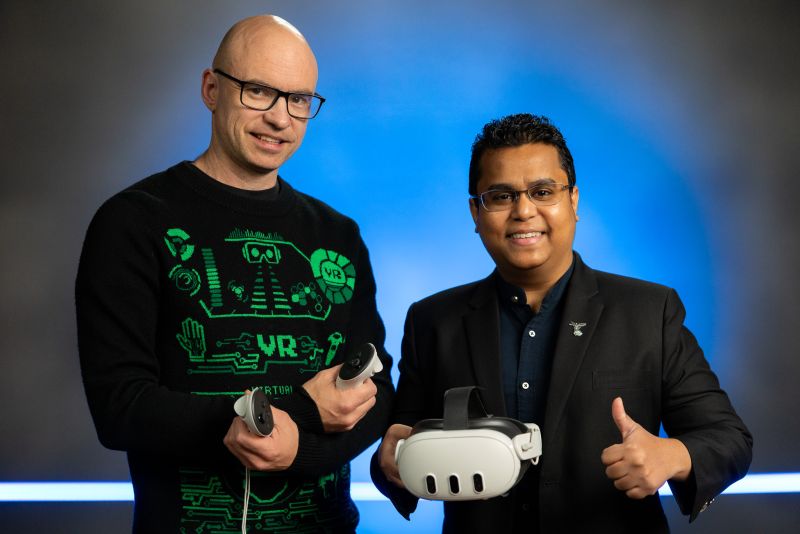
Mr Ben Loveridge and Dr Donnie Adams
A unique blend of VR, AI and leadership development
This project is not simply about using VR in teaching. It brings together VR, AI, and leadership development in a distinctive way.
“The key lesson from this project is that immersive learning should not be treated as an add-on to teaching. To be meaningful, it needs to be carefully embedded into the curriculum and aligned with students’ learning needs,” said Dr Adams.
He added that while VR is a powerful tool, the technology itself is not the focus.
“What matters is how we use it to create authentic learning experiences. In this project, VR provides the immersive environment, AI enables responsive interaction and analytics-informed feedback.”
The project shows in immersive learning students are placed in realistic situations where they must think, speak, respond, and reflect as leaders. One of the most important lessons we learned is that immersive learning works best when it is integrated into the subject, rather than offering it as an extra activity.
“When we embedded the VR activity into scheduled class time, participation improved substantially. This matters because students are more likely to engage when the experience is connected to what they are already learning,” Dr Adams explained.
The project also highlights the importance of facilitation. Teaching teams, researchers, VR specialists, and student facilitators all played an important role in supporting participants, refining the workshop experience, and ensuring that the technology served the learning purpose.
The work is still developing, but its promise is clear. It offers a new way to prepare leaders for the realities of school life: not only by teaching them what leadership is, but by giving them the opportunity to experience leadership, practise difficult conversations, and build confidence in action.
This project was funded through a 2024 Learning and Teaching Initiatives Grant at the University of Melbourne. For more information, please contact Dr Donnie Adams at donnie.adams@unimelb.edu.au