Teaching sovereignty in crisis times: Professor Linda Tuhiwai Smith opens the 2026 Dean’s Lecture series
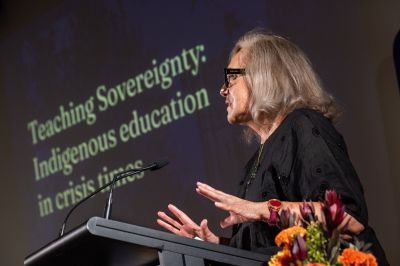
The University of Melbourne Faculty of Education launched its 2026 Dean’s Lecture Series with a powerful and deeply reflective address from Professor Linda Tuhiwai Smith, one of the world’s most influential voices in Indigenous education and decolonising research.
Opening on the lands of the Wurundjeri Woi-Wurrung people of the Kulin Nation, Dean Professor Marek Tesar grounded the evening in place, season and story acknowledging not only Country, but the waterways, histories and knowledge systems that continue to shape learning. It was a fitting prelude to a lecture that would challenge, unsettle, and ultimately reimagine the purpose of education.
Education beyond crisis
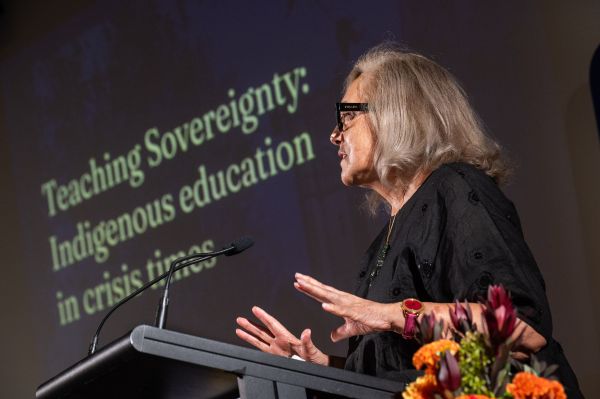
In her lecture, Teaching Sovereignty: Indigenous Education in Crisis Times, Professor Smith invited the audience to reconsider what education is for and who it serves. While Indigenous communities have long lived within conditions of imposed crisis, she argued that the task of education is not simply survival within these constraints, but the active creation of futures grounded in sovereignty.
Sovereignty, she noted, is an imperfect but necessary term, one borrowed from Western political traditions and repurposed by Indigenous peoples to articulate aspirations of self-determination.
Yet for Māori communities, concepts such as mana motuhake (sovereignty) and tino rangatiratanga (self-determination) more closely express the depth of these aspirations: authority, dignity and connection to land, language, and people.
Teaching as relational, creative, political – and importantly - reciprocal
Drawing on her own life, from growing up in rural Māori communities to her early career as a teacher, Professor Smith reflected on enduring impacts of colonial education systems.
She described how deficit-based models once framed Indigenous students as lacking knowledge, language, and value, requiring schools to “compensate” by erasing what they brought from home.
Against this, she reframed teaching as a profoundly relational and creative act. Teaching, she argued, is not merely instruction, but an act of love, recognition, and healing.
It involves nurturing identity, restoring knowledge, and enabling learners to name and understand their experiences including racism, marginalisation, and resilience.
Critically, she emphasised that teaching must also be reciprocal. Students bring knowledge, language and insight into the classroom, and meaningful learning emerges through relationships that redistribute power rather than reinforce it.
Community as the site of learning
Throughout the lecture, Professor Smith illustrated how education for sovereignty is already happening often outside formal institutions. From language revitalisation movements and kura kaupapa Māori schooling (Māori immersion schooling), to community-led research, food sovereignty initiatives, and intergenerational knowledge sharing, she presented a rich tapestry of practice grounded in community.
“Teaching is not confined to classrooms. It happens in gardens, kitchens, protest movements, doctoral writing groups, and family networks. It is enacted by elders, activists, parents, and young people alike.”
She stated that the role of educators in addressing intergenerational trauma contradicts conventional models such as “trauma-informed care” which she said, “often fall short.”
“True healing,” she suggested, “is collective, long-term and embedded in relationships, requiring honesty, creativity and care across entire communities.”
Honouring activism, shaping futures
A recurring theme was the importance of remembering and honouring Indigenous activism. Reflecting on her own involvement in movements such as Ngā Tamatoa, Professor Smith described a generation driven not by anger, but by hope and belief in change.
These efforts laid the foundations for language revitalisation, political representation and cultural resurgence seen today.
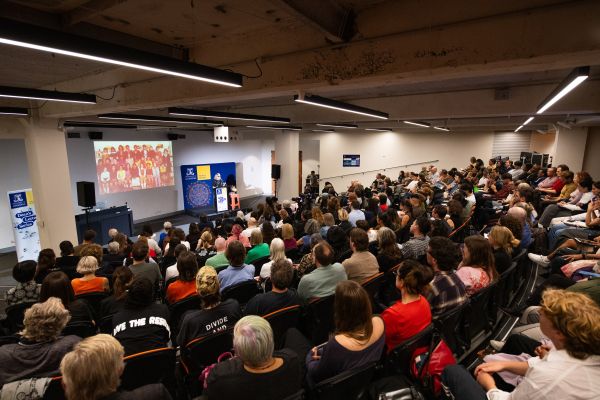
Importantly, she challenged educators to ensure these histories are told accurately and collectively. “Resist simplified narratives that privilege individual “heroes” over community action,” she noted that the roles of women, often thought to be in the background to the men, were inaccurate, much to the pleasure of the packed audience.
Teaching for the world we imagine
In closing, Professor Smith posed a critical question: can we teach not just for survival in crisis, but for a future where Indigenous sovereignty is realised?
Her answer was unequivocal. Education, she argued, must be oriented toward possibility. The success of Māori language revitalisation, once considered improbable, demonstrates that transformative futures can be imagined and achieved through sustained, collective effort.
The task for educators, then, is to prepare learners not only to navigate the present, but to build the worlds they envision.
A resonant beginning to 2026
The evening concluded with reflections from Deputy Dean, Professor Elizabeth McKinley, who highlighted the enduring importance of reclaiming and valuing Indigenous knowledge systems. The event also marked a moment of connection across communities, with distinguished guests and scholars joining from across Australia and Aotearoa – New Zealand.
As the first lecture in the 2026 series, Professor Smith’s address set a compelling tone, one that calls the education sector to move beyond critique and toward action.
In a time often defined by uncertainty, her message was both clear and urgent: education has the power not only to respond to crisis, but to create sovereign futures.