Indigenous women leaders call for structural change for IWD26
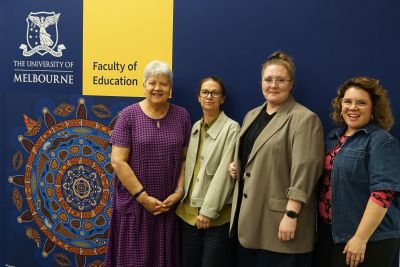
International Women’s Day at our Faculty of Education was marked by a powerful and deeply reflective conversation led by Indigenous women leaders across the University of Melbourne, challenging the audience to move beyond celebration toward action.
Framed around the United Nations Australian theme Balance the Scales, the panel brought into sharp focus the realities of inequity that persist within education systems.
Realities that are often obscured by surface-level progress.
Rather than centring institutional achievements, the discussion asked a more difficult question: what does genuine equity look like when Indigenous voices are truly at the centre?
“Equity isn’t about being invited into existing systems; it is about reshaping those systems altogether.”
The conversation made clear that inclusion without power-sharing is not inclusion at all. Indigenous women continue to lead across communities, classrooms, and research spaces, yet remain underrepresented in decision-making structures. This imbalance, panellists argued, is where the real work must begin.
Beyond representation: rethinking systems
A key theme that emerged was the distinction between representation and transformation. While institutions often point to increased diversity as a marker of success, the panel challenged whether this translates into meaningful change.
True equity, they argued, requires a shift in who holds power, whose knowledge is valued, and how systems are designed. It also requires discomfort; a willingness to confront the historical and ongoing impacts of colonisation within education.
“We cannot measure progress only in numbers. We must ask who is being heard - and who still isn’t.”
This provocation resonated strongly with the audience, prompting reflection on how universities and schools can move beyond performative commitments toward structural reform.
Leadership as legacy and responsibility
The panel also highlighted the intergenerational nature of Indigenous leadership. For many speakers, leadership is not an individual achievement but a collective responsibility, one grounded in community, culture and continuity.
Stories shared throughout the event underscored the strength and resilience of Indigenous women who have sustained knowledge systems despite systemic barriers. These narratives reframed leadership not as something granted by institutions, but as something carried forward through generations.
“Our leadership didn’t start in boardrooms, it started in community, in culture, and in care.”
This perspective challenges dominant leadership models within education, offering a more relational and holistic understanding of influence and impact.
The role of universities in driving change
For the Faculty of Education and the broader University of Melbourne community, the event served as both a moment of reflection and a call to action.
Panellists emphasised that universities have a critical role to play, not only in amplifying Indigenous voices, but in embedding Indigenous knowledge systems into the fabric of teaching, research and leadership. This work cannot be confined to isolated initiatives; it must be integrated, sustained and accountable.
“If we are serious about change, we have to move from consultation to co-design.”
This shift requires long-term commitment, as well as a willingness to rethink established practices and priorities.
A call to collective action
More than a panel discussion, Balance the Scales was a collective invitation to reimagine what equity in education can and should look like.
The conversation reinforced that progress is not linear, and that meaningful change often requires sustained effort over time. Yet it also highlighted the power of community, solidarity and shared purpose in driving that change forward.
For those who attended, and those who will engage with the recording, the message is clear: balancing the scales is not the responsibility of a few, but a collective effort that demands courage, accountability, and action.
Watch the full recording of the event here: