Bringing science home: how rural students are finding their place in STEM
What happens when cutting-edge science comes to a classroom and keeps coming back?
For students in regional Victorian schools, the answer may be helping to reshape how they see science, scientists and their own futures.
Research by University of Melbourne Faculty of Education academics Associate Professor Victoria Millar and Dr Maurizio Toscano is exploring the impact of a long-term science outreach program delivered in schools in western Victoria, alongside researchers from the ARC Centre of Excellence for Dark Matter Particle Physics.
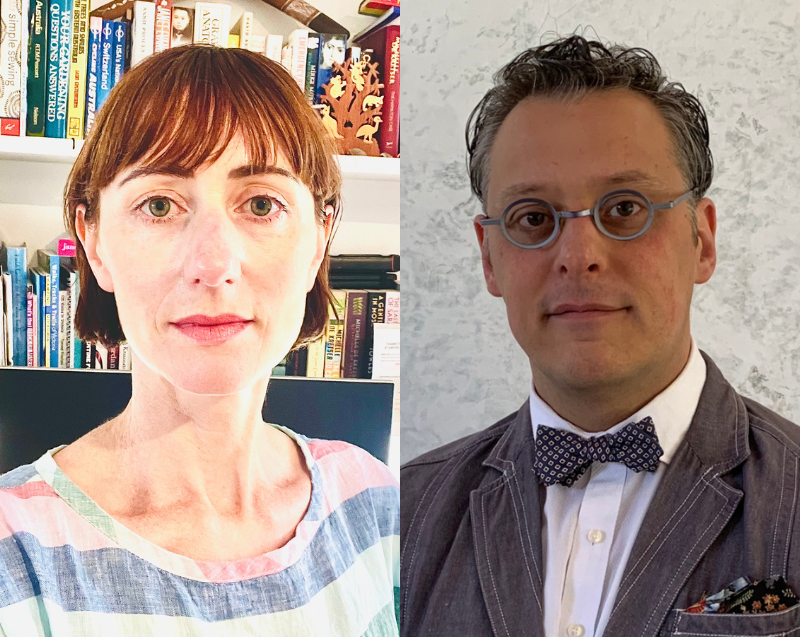 Associate Professor Victoria Millar and Dr Maurizio Toscano
The research is providing rare longitudinal insight into how sustained contact with practising scientists influences students' engagement with science, their sense of belonging and understanding of where STEM fits into their lives.
The project began in 2022 and follows students through secondary school in Stawell, Hamilton and Ararat.
Fittingly, the research aligns with National Science Week 2026, and its theme, Seeds of Science: Nurturing Knowledge for All.
Bringing cutting-edge science with a distinctly regional connection
The Centre's research is focused on one of the biggest unanswered questions in modern physics: what is dark matter, the mysterious substance thought to make up much of the universe?
The content of the outreach makes a difference. Dark matter is not a neat textbook chapter with a definitive answer; it is science still under investigation.
“Dark matter is such an exciting idea and quite unlike many ideas found in traditional textbooks,” explains Associate Professor Millar. “It’s highly abstract and takes a lot of careful thinking about how to help students understand.”
Students encounter scientists working with uncertainty and trying to understand something that remains mysterious.
“They're seeing that science is alive, it's dynamic,” Dr Toscano says.
The Centre's dark matter experiment is located one kilometre underground in a laboratory at the Stawell Gold Mine.
"The communities and schools are incredibly proud to have this international and cutting-edge physics research happening so locally," Associate Professor Millar says.
“That local connection changes how students imagine the science,” Dr Toscano adds.
“Rather than something happening in a distant university or research laboratory, cutting-edge physics is happening in a place they know, somewhere their families and communities are connected to.”
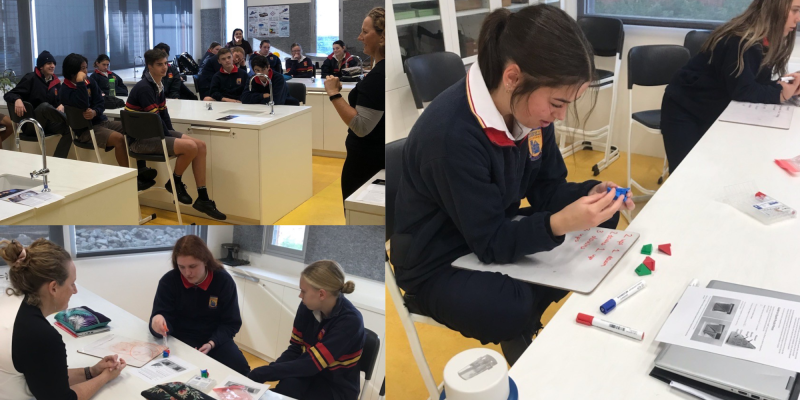
Senior Outreach and Education Manager Jackie Bondell with Stawell Secondary College students
The power of scientists coming back
A key feature of the outreach program is its continuity. Scientists don't simply arrive at a school and disappear; they return to work with the same students as they move through secondary school.
“That continuity helps challenge the idea of outreach as a one-off performance,” Dr Toscano says. “Instead, scientists become familiar figures, people students can talk to and ask questions of.”
More than making students ‘like’ science
A major focus of the research is science identity, how young people begin to see themselves, and be recognised by others, as belonging in science.
“We know that how young people identify with science can have a long-term influence in how they value and engage with science throughout their lives,” Associate Professor Millar says.
Meeting practising scientists gives students opportunities to develop aspirations and see possible STEM pathways.
Research suggests that outreach can help students recognise the science already embedded in the lives and careers around them. Modern agriculture, for example, increasingly draws on data analysis, drones, technology and other scientific and technical skills.
“Even though they might not end up pursuing a career in STEM, the outreach is improving their appreciation and valuing of STEM,” Dr Toscano says.
The strength of rural communities
Regional and rural communities are often described through distance from metropolitan centres, socioeconomic disadvantage and reduced access to museums and science centres. But the research suggests a more nuanced picture.
“Rural communities also offer powerful assets: belonging, community, place and strong social connections,” Dr Toscano says. “Those qualities can become part of the science outreach experience rather than obstacles to it.”
“When you bring science into the classroom in a different way, those wonderfully positive aspects of community also come along for the ride.”
A seven-year experiment in belonging
The Centre’s seven-year funding has allowed the researchers to follow the outreach program over a much longer period than is typical.
Science outreach is widespread but remains under-researched relative to the scale of activity.
“We are really trying to understand the detail of how these programs can make a positive difference to young people's longer-term identification with science,” Associate Professor Millar says.
Associate Professor Millar and Dr Toscano are interested in deeper questions: How does sustained outreach shape students' identities? How does it influence their aspirations? What does it mean for their relationship with science over time?
The findings could help science outreach organisations, schools and policymakers understand what makes engagement meaningful and sustainable.
For Dr Toscano, the most important lesson emerging from the research is simple: science belongs everywhere.
In rural Victoria, that can mean something particularly powerful, not bringing science to a community, but showing young people that science is already part of the place they call home.
“It's always about possibilities,” Dr Toscano says. “Students are seeing those opportunities and possibilities, and even when they don't become scientists, they can see why science matters.”