Seminar Series
Lori Huston
10 September 2026
Indigenous Heartwork Methodology
Lori Huston is a Métis scholar, Co-Director, Lecturer and Doctoral candidate in Early Childhood Education (ECE) at the University of British Columbia. Her research focuses on Indigenous heart knowledge in early childhood education and emphasizes relational approaches to learning that promote cultural understanding, enhance educators’ teaching methods, and support Indigenous sovereignty.
Louise Couceiro
30 June 2026
Equity, Technology, Teaching and Learning in Secondary Schools
Louise Couceiro, Postdoctoral Research Fellow, Childhood Studies at
the University of Melbourne Faculty of Education. Louise’s research is
primarily centred on children and young people and education, with
specific focus on social justice and inequalities. Her research interests
span children’s literature and literacies, children’s digital and technological engagements, and feminist issues. Louise has extensive
experience of using qualitative methods, including undertaking in-depth ethnographies and using creative and participatory approaches.
Jose Antonio Gordillo Martorell
23 April 2026
Children’s participation and co-creation in cultural organisations
Jose Antonio Gordillo Martorell, Ph.D., is the Founder and CEO of Cultural Inquiry. Sharing inspiring examples of his work establishing children's boards in museums all over the world, Jose will unpack the concept of the children's board as explored in his recent research "Children’s Boards in Museums". The book is essential reading for academics and students who are engaged in childhood studies and interested in museums, the arts, and cultures that push beyond an image of the child as a passive consumer.
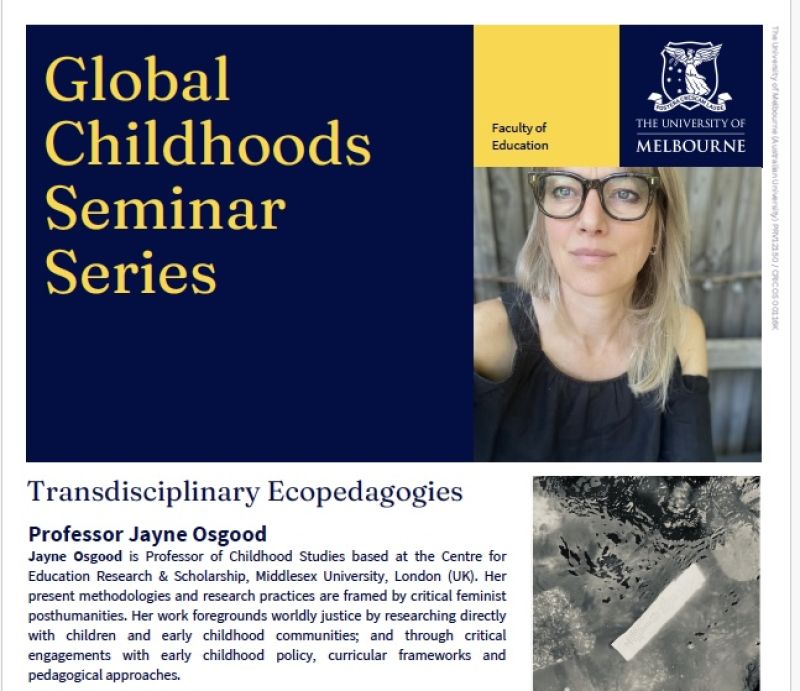
Jayne Osgood
24 February 2026
Transdisciplinary Ecopedagogies
Teaching eco-critically means to understand and take issue with human exceptionalism and the complex aspects of environmental issues from local to global perspectives and knowledges, as well as through the scholarship of multipledisciplines. In this seminar Professor Osgood explores why it is essential to detemmine actions for lasting changes toward environmental wellbeing and planetary survival.
Mara Krechevsky and Ben Mardell
5 November 2025
"The Leaf People": An exercise in collective imagination
In this presentation, Mara Krechevsky (Project Zero, Harvard University) and Ben Mardell (Newtowne School Cambridge, MIT) share examples of speculative fiction and world building with young children, leading an exercise in collective imagination.
Bill Cope
1 July 2025
Generative AI in Education: Implications and Applications
In this seminar Professor Bill Cope explores Generative AI in Education: Implications and Applications. The session includes a demonstration of CyberScholar - an AI supported writing space and experimental learning environment that establishes a dialogue between artificial and human intelligence or “cyber-social learning” in which fundamentally different intelligences work in symbiotic relation.
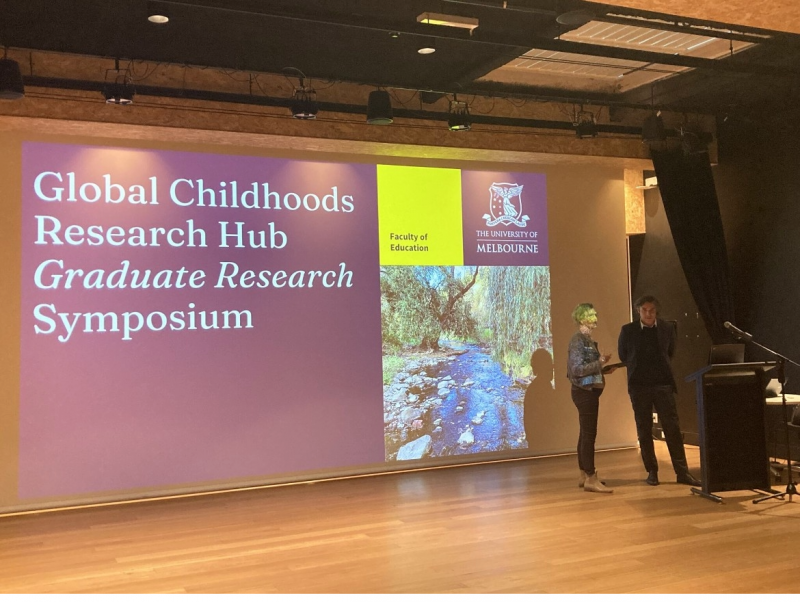
Global Childhoods Graduate Research Symposium
June 25, 2025
Global Childhoods Graduate Research Symposium
This half-day symposium showcased graduate researchers from the Global Childhoods Research Hub. Each presentation included provocations for supportive and collaborative discussion, drawing together the threads of possibility emerging from the hub while creating transdisciplinary research relationships. Papers in progress were presented but not recorded. They included University of Melbourne Graduate Researchers at various stages of candidature: Viki Wang, Maya Starr, Dr Melina Mallos, Kylie Payman, Sonia Pranatha, Malini Chidambaram and Pete Crowcroft.
Will Parnell
22 May 2025
Finding our way into the Hundred languages of children
In this engaging conversation Professor Parnell introduces his work with the Inventing Remida Portland Project and Helen Gordon Center. Sharing recent experiences with teachers and children working in a digital atelier Will situates a culture of reuse, rethinking children’s digital worlds, and engaging with notions of documentation for equity and justice.
Nikki Rotas
2 April 2025
Non-Canonical Philosophy with Children
In this seminar Dr Nikki Rotas shares her research in Toronto, Canada which employs Non-Canonical Philosophy as conceptual and methodological research-creation to enable inclusive exploration of philosophy with children.
Global Childhoods Research Symposium Opening Remarks– Nicola Yelland & Ame Christiansen
20th February 2025
Creating Research Possibilities: Collaborative Futures
Bringing together international researchers from the Global Childhoods Research Hub, the Symposium featured Big Ideas Talks- short sessions exploring big ideas and even larger possibilities. Nicola Yelland and Ame Christiansen introduced the symposium, highlighting the future of early childhood research across diverse global contexts.
Andreas Jacobsson
Intercultural Dimensions for Global Childhoods
Andreas Jacobsson, PhD film studies, senior lecturer in child and youth studies at the University of Gothenburg, Sweden. Jacobsson is co-convener of the Global Childhoods research group at the University of Gothenburg. Jacobsson’s research interests include global childhoods, early childhood education, (audiovisual) media, childhood, and interculturality.
Anette Hellman
Intersections on childism, competence, and innocence. Norms on children’s active participation and bodily integrity in Swedish Preschools
Anette Hellman, Senior lecturer and Associate professor in the Faculty of Education, Communication and Learning at the University of Gothenburg, Sweden.Her research interests include issues related to critical childhood studies and social justice in education. Hellman was the national project leader in Sweden for the project “Learning Spaces for Inclusion and Social Justice: Success Stories from Immigrant Students and School Communities in Four Nordic Countries” founded by Nordforsk. Hellman is the national president of OMEP in Sweden, especially engaged in issues such as young children’s education and wellbeing. She is also the director of the Global Childhoods research group at the University of Sweden and has written extensively in the research field of gender, care, and ECEC.
Nerita Waight
Victorian Statewide Treaty and Indigenous Childhoods
Nerita Waight is a Yorta Yorta and Narrandjeri woman with Taungurung connections. Nerita is the CEO of the Victorian Aboriginal Legal Service. Nerita was first employed at VALS in 2014 as a civil lawyer. Prior to becoming CEO, Nerita had experience across several teams in the organisation including family and children’s law, as well as policy and advocacy.
Noreen Naseem Rodriquez
Creating Transformative Possibility in Schools and Communities through Asian American Studies
Noreen Naseem Rodríguez is an Assistant Professor of Elementary Education and Educational Justice in the Department of Teacher Education and core faculty in the Asian Pacific American Studies and Muslim Studies Programs at Michigan State University. She is co-author of Social Studies for a Better World: An Anti-Oppressive Approach for Elementary Educators with Katy Swalwell and Teaching Asian America in Elementary Classrooms with Sohyun An and Esther Kim. Before becoming a teacher educator, Noreen was a bilingual elementary teacher for nine years.
John Tobin
Children’s Rights in International Law
Professor John Tobin is the Francine V McNiff Chair in International Human Rights Law in the Melbourne Law School, Co-Director of Studies for the Human Rights Program in the Master of Laws & Co-Director of Research in Human Rights within the Institute for International Law and the Humanities. His research interests cover the broad field of international human rights law but he has a particular interest in children's rights and the right to health.
Kate Coleman & Sarah Healy
Workshop on Creative Educational Practices
Dr. Kathryn Coleman is associate professor in Visual Arts & Design Education at the Faculty of Education, The University of Melbourne. Her research into practice includes creative practices, practices of identity, knowledge as practice and digital practices. Artist-researcher-teachers have different ways of understanding knowing and they explore ideas as a living inquiry, chasing ideas and running with concepts until they make something that opens a new space.
Dr Sarah Healy is co-lead of SWISP Lab (Speculative Wonderings in Space and Place) with Associate Professor Kate Coleman. Sarah is a speculative a/r/tographer and works across creative and art education ecologies. She is an inaugural Melbourne Postdoctoral Research Fellow in the Faculty of Education at the University of Melbourne and elected World Councillor for The International Society for Education Through Art (InSEA) in the Global South. As a non-governmental organization and official partner of UNESCO, Sarah’s leadership in the region seeks to promote and advance education through art, design, and crafts in Southeast Asia and Pacifica. Sarah is best known for her contributions to the fields of critical affect studies, data creation, digital methods, and post-humanities.
Gabriella Pataky
Risks and Responsibility in the Light of Education trough Art related Early Childhood Development
Gabriella Pataky Ph.D. is the head of the Department of Visual Education and the director of the Art Teacher Master’s Program at Eötvös Loránd University Faculty of Primary and Preschool Education (ELTE TÓK), working at the Moholy-Nagy University of Art and Design (MOME) in Budapest as well. As a founder of the 3612+ Visual Skills Lab, the aim of her enthusiasm is to continuously renew art education, assist in its adaptation to current professional and social requirements, support the decision-making process in educational matters as well as accumulate and spread knowledge concerning art education and its environment.
Ame Christiansen
Emerging insights from the Early Childhood Teacher and Educator Neurodiversity Project
Dr Ame Christiansen is an Early Career Researcher and lecturer in the Early Childhood Studies Academic Group and Global Childhoods Research Hub at the University of Melbourne. Her doctoral thesis 'Reconceptualising disability and inclusion: Enacting relational ways of knowing, being and doing with Bush Kinder' was awarded the John Smyth Award for research excellence in the Doctor of Education in 2024. Ame's teaching and post-qualitative research rethinks dominant conceptions of ‘inclusion’ and ‘disability’ in early childhood studies, by engaging with post-foundational, new materialist and critical post-humanist onto-epistemologies.
Eyueil Abate
Training and the Competence of Teachers Providing Education in Emergency in Contemporary Ethiopia
Dr. Eyueil Abate is an esteemed Assistant Professor at Kotebe University of Education, where he serves as the Director at the Institute University of Education. With a dedicated career spanning over 18 years in education, Dr. Abate has made significant contributions at various educational levels, from primary education to university instruction. Having earned his Ph.D. from Addis Ababa University, Dr. Abate specialized in Curriculum Design and Development, focusing particularly on the challenges and needs of refugee education. His research delves deeply into the complexities of war and conflict-related trauma affecting children, allowing him to bring a vital understanding of these pressing issues into his educational practices and curricula.
Mariana Souto-Manning
18th February 2025
Whose Childhood Counts? Reclaiming and Redefining Childhoods Beyond Limiting Narratives
Professor Mariana Souto-Manning guides listeners in reimagining childhoods that embrace every child's full humanity, charting a transformative path toward pluralistic, liberated childhoods rooted in justice, equity, and freedom.
Alison Clark
2nd Oct 2024
Reasons to be slow: Challenging the intensification and acceleration of childhood
Taking inspiration from the slow movement, the two year study ‘Slow knowledge and the unhurried child’ explored alternatives to the increasingly measured and tested cultures of acceleration in Early Childhood Education and Care.
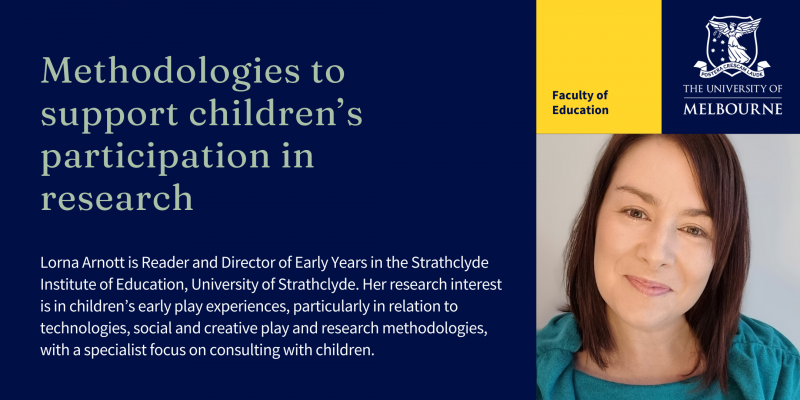
Lorna Arnott
5th June 2024
Methodologies to support children's participation in research
Based on her edited book Research through Play: Participatory Methods in Early Childhood, this presentation offers insight into research with very young children using play inspired methods and methodologies. As progress is made in children’s rights and the understanding that children are capable and competent, children should be included in research data; particularly data pertaining to them. Data collection processes require nuanced and reflexive approaches which maintain high ethical standards and research rigor. Come hear Dr Arnott share examples of research approaches with children, articulating tensions and dilemmas in conducting this work.
Sarah Pink
8th April 2023
Design Ethnographic Filmmaking
In this talk, Sarah discusses the practice of design ethnographic filmmaking, through the examples of her recent documentary film projects.
Sarah positions design ethnographic filmmaking as part of a new futures focused agenda for the social sciences, and her talk also advocates for a shift in the way in which we engage in the futures space, in relation to other academic disciplines and non-academic stakeholders. Such a movement, Sarah will argue, is necessary for the social sciences to be able to participate in shaping the agendas and pathways towards possible futures that are so much needed.
Kate Coleman and Sarah Healy
19th October 2023
Young People in Anthropogenic Times: Expanding Definitions of Childhoods, Pluricultural Climate Stories and Knowledge Mobilisation
This seminar introduces SWISP Lab, a research lab directed by Kate Coleman and Sarah Healy that is located within the Global Childhoods Research Hub, and its global climate project called HAK.io. The project seeks to collaboratively practice with youth – as defined by the UN – to produce a pluricultural approach to climate education. We do this by hacking the Anthropocene beginning with climate stories, often not just of individuals but entire communities and families, which provide insight into the complex relations between humans, technology and the land.
Marek Tesar
8 March 2023
Professor Marek Tesar presented a theorisation of global childhoods, addressing philosophies, theories, pedagogies and methodologies that shape this field. He focused on global and local discourses and charted current challenges and opportunities of global childhoods scholarship and practices.
Mariana Souto-Manning
1 December 2022
Professor Mariana Souto-Manning explores the commitment to pursue justice and foster belonging in early childhood teaching and teacher education as a moral and ethical imperative for our profession.
Eugenia Arvanitis
27 July 2022
Associate Professor Eugenia Arvanitis presented current research data on refugees’ narratives in Greece and engaged in dialogue with her Australian colleagues so to establish a common understanding on relevant issues.
Ian Hamm and Nerita Waight
1 June 2022
Nerita Waight and Ian Hamm started our seminar series off to present ways in which they work to elevate social justice and equitable representations of Aboriginal people on boards and other high-level governance, through strategic action, advocacy and mentoring.