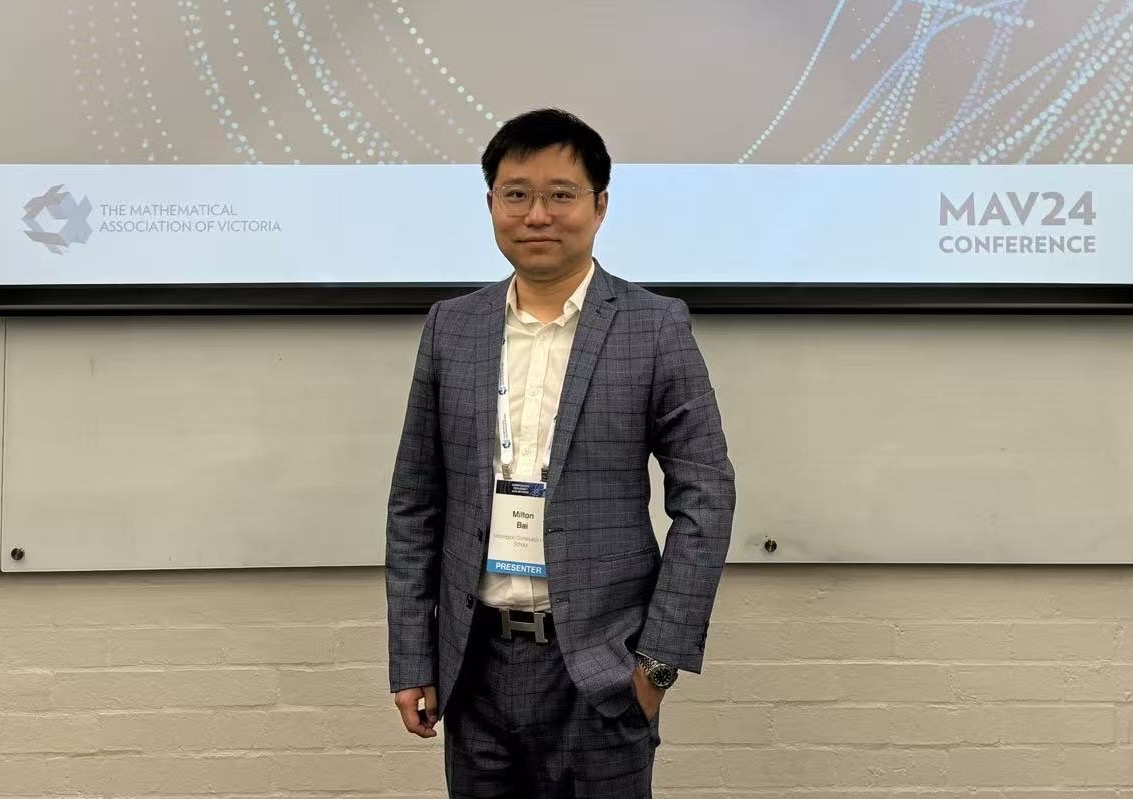
Milton Bai, a dedicated Maths teacher and Placement Coordinator at Kensington Community High School, is passionate about creating inclusive learning environments and shaping the next generation of educators. A graduate of the Master of Education in 2019, Milton reflects on how the collaborative and diverse learning experiences at the Faculty of Education expanded his perspective on what it means to be an impactful educator. Today, he combines his love for teaching mathematics with his commitment to student wellbeing and professional development, making a meaningful impact on both his school community and aspiring teachers.
1.What course did you study at the Faculty of Education (then MGSE)?
I graduate from the Master of Education program in 2019.
2.What do you remember fondly from your time there?
As I already had my teaching degree before I went to the University of Melbourne, this Master of Education became a remarkable extension of my teaching practice.
I remember the strong collaboration and communication among my lecturers, tutors and peers. The collaborative learning environment, especially during tutorials, helped me grow both professionally and personally.
I really valued the diverse perspectives we shared in class. Learning alongside educators from different school settings, cultural backgrounds and the wider community provided me with the opportunity to understand not only how to be a classroom teacher, but also the bigger picture of education. It strengthened my vision of becoming a visionary educator. These experiences continue to inspire and encourage me to reflect deeply on the kind of teacher I aspire to be.
3.What do you love most about your current role?
Currently, I’m a maths teacher at Kensington Community High School, and I am also the pre-service teacher placement coordinator. What I love most about my current role is the opportunity to make a meaningful impact on both my school community and pre-service teachers from universities.
From a teaching perspective, teaching maths allows me to help students build confidence in a subject that many initially find challenging, and to reach their full academic potential. It’s incredibly rewarding to see students’ growth over time. From an engagement and wellbeing perspective, the unique inclusive learning environment at KCHS ensures that every student is empowered to grow into a confident, compassionate, and capable individual. I also endeavour to create more opportunities for my students to develop their soft skills and life skills, in addition to textbook knowledge. I’m glad to see many of my students becoming active members of the broader community and achieving their personal best.
Another important part of my role is coordinating the pre-service teacher placement program, which is also how I reconnected with the Faculty of Education (FoE). It feels wonderful to have the privilege to work with FoE staff and help prepare the next generation of teachers, just as my mentors once did for me. I value the opportunity to share some of my own experiences with teacher candidates during their placements and to support them in building a clear pathway into the teaching profession.
4.What helped you most as a graduate teacher when you first started out?
The school where I started my teaching career is also my current workplace – Kensington Community High School, a designated purpose school that provides an alternative setting for students whose needs are not met in mainstream schooling, and that encourages their re-engagement with education.
In terms of my workplace, what helped me most as a graduate teacher was the support of colleagues and school leadership, who generously shared their time, resources, and advice with me. Further to this, in terms of my university preparation, I found that the contemporary educational theories and reflective pedagogies I developed during my time at FoE gave me a strong foundation to continuously develop my practice, especially in areas such as Promoting Positive Learning, Learners and Learning Difficulties, and understanding diverse learner needs. My learning experience at the University of Melbourne has aligned closely with my teaching philosophy in an alternative setting: to create a thriving learning community where diversity is celebrated, inclusion is embedded, and futures are forged with purpose and possibility. This vision has strongly guided me in creating an environment where every student is empowered to grow into a confident, compassionate and capable individual.
From a personal perspective, what has helped me most is maintaining an open mindset. At KCHS, I have applied more engagement and wellbeing led, connection focused strategies for my students. Staying open to an inclusive school culture has really helped me grow in confidence and capability as a teacher, both professionally and personally.
5.What advice can you give current students about how they approach placement?
As the placement coordinator, over the years I have noticed that the key word for both placements and your future teaching journey is “connection”. Connect with the school environment, build strong relationships with students, colleagues, and the wider community during every single day of your placements can make all the difference; Connect with yourself as well, because it’s always essential to allow time for your personal growth during placements, and to allow spaces to build your own teacher identity. Always maintain a willingness to learn from every lesson during your placement, reflect on yourself and your practice, and keep improving; Connect the theories you have learned at university to the lessons you deliver during placements. All the skills, strategies and training we gain from university are valuable. Trying out these ideas and approaches in the classroom, and adapting them to your context, is always beneficial.
Most importantly, no matter how challenging the journey becomes, always return to the ‘why’ that led you into teaching, and let that spark of purpose keeps your enthusiasm and passion alive.
Learn more
Master of Education Explore all our courses