Why were you interested in graduate research study at FoE?
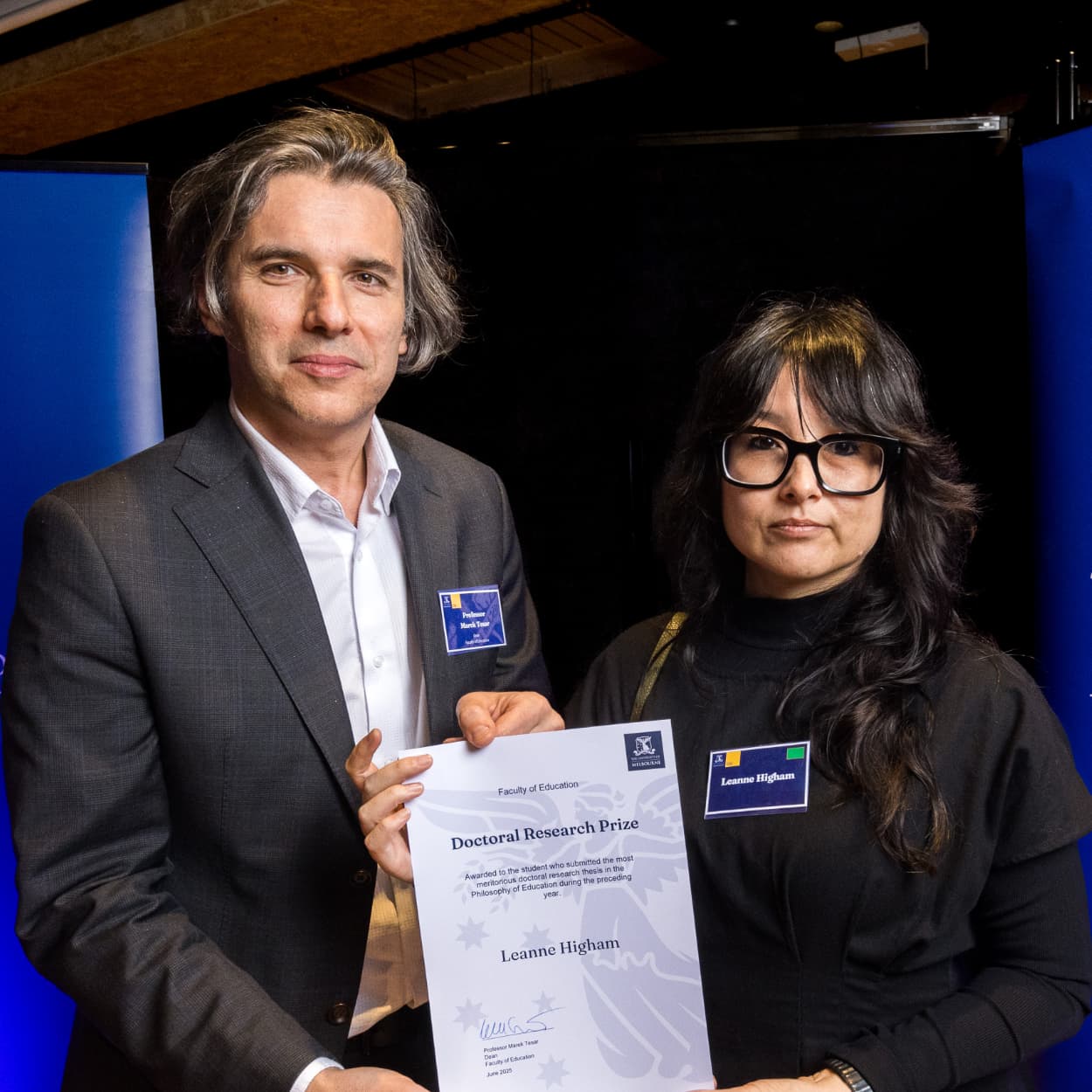
As a teacher attempting to make meaning of everyday school life around me, I was attracted to the sociocultural work of Education theorists at FoE such as Dianne Mulcahy, Julie McLeod, Fazal Rizvi, and Johanna Wyn. In one of my subjects, ‘Diversity, Inclusion, and Transitions’, Hernan Cuervo strongly encouraged me to pursue graduate research. Still working full time as a teacher, I undertook my master’s by research under the supervision of Dianne Mulcahy and Johanna Wyn, writing my thesis Becoming boy: A/effecting identity in a Catholic boys’ school. This thesis was awarded the 2016 Freda Cohen Prize. Feeling affirmed and bolstered by a growing sense of belonging in the world of academic scholarship and research, I left teaching to undertake a PhD. This work, supervised by Dianne Mulcahy and Jane Kenway, resulted in my thesis Slow violence and nonviolence: Violence, affect, and everyday schooling.
What was your thesis topic? What did you find? Maybe a shortened thesis abstract
My thesis worked deliberately with the problematic topic of violence to explore how the concept of slow violence might expand existing understandings of violence in schools, and how such an expanded conceptualisation might advance a relational, practical ethics of nonviolence. It offers critical insights into violence that is usually overlooked in studies of school violence, providing a fresh way of looking at longstanding, intangible problems in schools, and imagines possible directions for future studies of slow violence and nonviolent pedagogical praxis.
Put plainly, the thesis theoretically and empirically examined the limitations of narrowly defined understandings of violence—e.g., assault, bullying, homophobia—showing how these can mean we fail to recognise and thus address violence that exceeds such limited scope. My thesis offers slow violence as a means for understanding the emergent operation and cumulative effects of violence, and advocates nonviolence as a relational and responsive ethical practice with which we might respond.
Why was this topic of interest to you?
After my master’s thesis I had initially planned to follow with a PhD study of marginalisation of masculine identities in schools. The more I read during my literature review, the more I understood the potential limitations of such a narrowed approach. In addition, the social, cultural and political context shifted significantly during this period, coalescing around what Judith Butler describes as the anti-gender ideology movement.
Taking up the lens of slow violence affords a more capacious approach, one that can take in but is not limited by gender. In my thesis, I developed the notion of slow violence as a portable, more-than-human concept untethered to any specific form of violence, humans, or places. I offer a way to examine processes of violence over time that is context-agnostic and could potentially be taken up in any educational context, to examine its accretive effects at scales ranging from the micro to macropolitical.
My approach seems to have been a generative and productive line of argument. My work on slow violence has been cited in academic literature exploring Australian and international contexts ranging across sexuality education; gender in early childhood education; gender and schooling, and gender-based violence in education, to class in higher education; English-teaching pedagogy; the unintelligibility of science education; affective school climates, and pedagogy of discomfort.
How has this topic changed your view of education?
When I look back to my initial forays into postgraduate study in Education, I now recognise I was a teacher in search of solutions. Closely examining a so-called ‘wicked problem’ like violence has really illuminated, for me, how education is complex, located across multiple disparate and often competing paradigms, underpinned by a range of differing values. For me this is why I consider that how we approach complex problems must be through nuanced responses that are specific to their contexts, and not one-size-fits-all solutions that are positioned to be universally applicable.
What are your plans having undertaken this research and how will this build on your thesis?
I have been publishing journal articles from my thesis and plan to publish the thesis as a monograph. Looking further ahead, my thesis has set me up to intricately examine longstanding problems in education (and society more broadly), and to then explore how things might be done differently. I am currently working on two smaller-scale research projects in schools, one concerned with school climate an alternative school, the other concerned with gender and school cultures in a newly co-educational school. While external factors mean it is occurring a little sooner than I had anticipated, I am in the midst of planning a larger-scale research project as I work on my application for an Australian Research Council Discovery Early Career Research Award (DECRA).
What key piece for advice would you give to a new graduate researcher in FoE?
You are surrounded by some of the best and brightest Education academics in the world. Show up for faculty events. Listen to speakers. Connect with your peers. Network with other academics. Read, but also write! Present your developing work at conferences (AARE!), at specialised symposia, at seminars, at workshops. You are immensely privileged to be part of this world: Don’t isolate yourself from the academic community, be present and immerse yourself in it. Soak up and cherish this experience, it will be over before you know it!
Learn more
Doctor of Philosophy (Education) Explore all our courses